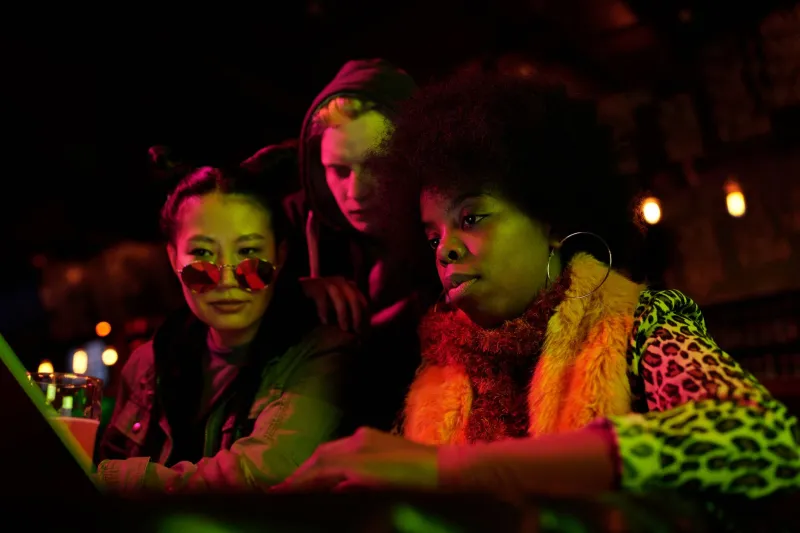
47 People and a Shared Obsession: Why the Smallest Internet Rooms Are the Most Alive

Somewhere right now, there is a Discord server with 47 members who are deeply, almost violently passionate about a single style of lo-fi drum programming that peaked in obscurity between 2003 and 2007. They share samples. They argue about compression ratios. They have inside jokes that would take three paragraphs to explain to an outsider. They are, by nearly every metric, having a better time online than you are.
This is not a coincidence.
The Algorithm Made Everything the Same Flavor
Here's the thing nobody wants to say plainly: the mainstream internet is exhausting in a very specific way. It's not loud or offensive or dangerous — well, it's those things too — but the more insidious problem is that it's flat. The recommendation engines that power every major platform have spent years optimizing for engagement, and what engagement actually means, when you strip away the jargon, is content that provokes the widest possible emotional response in the largest possible number of people. Outrage. Nostalgia. Validation. Cute animals. Repeat.
The result is a cultural landscape where everything worth caring about gets sanded down to a palatable nub before it reaches you. A band gets discovered, gets a Spotify playlist placement, gets a brand deal, gets a hundred thousand new fans who vaguely like them — and in the process becomes slightly less itself. A visual aesthetic gets named, gets a TikTok hashtag, gets sold at Target. An inside joke becomes a meme format, then a T-shirt, then a Super Bowl ad reference. The pipeline from genuine to generic has never moved faster.
So people started going smaller. Much, much smaller.
If You Know, You Know — And That's the Whole Point
The phrase "if you know, you know" used to be a flex. Now it's more like a survival strategy. When you find a community small enough that the algorithm hasn't noticed it yet, you've found something genuinely rare: a space where the culture hasn't been pre-digested for mass consumption.
This is what's driving the migration toward hyper-specific subcultures. We're talking about Reddit threads dedicated to a single transit line's graffiti history. Facebook groups — yes, Facebook, because sometimes obscurity lives in unexpected places — for people who collect a specific regional brand of vintage ceramic. Discords built entirely around the appreciation of a single obscure film that got maybe 200 theatrical screenings in 2011 and has never been properly released on streaming.
These aren't niche communities in the old internet sense, where "niche" just meant "not mainstream yet." These are communities that are structurally resistant to going mainstream, because the interest is so specific that scaling it would immediately destroy what made it interesting. You cannot make a viral TikTok about the correct way to layer reverb on a 2004 Casio keyboard and expect the community to survive the attention intact. The specificity is the immune system.
Smallness as an Aesthetic and Ethical Choice
What's interesting — and this is where it gets genuinely cultural rather than just sociological — is that younger people aren't retreating into small communities purely out of exhaustion. For a lot of Gen Z especially, choosing smallness is a deliberate aesthetic and ethical stance.
There's a growing sense that participating in mass online culture is a form of complicity. Not in a grandiose political way, necessarily, but in the quieter sense that showing up to the algorithmic content machine and feeding it your attention and your reactions and your data is just... kind of gross? And opting out of that by going somewhere tiny and weird and unmonetized feels like a small act of integrity.
It also just feels better. There's a texture to small communities that large ones can't replicate. When you're one of 47 people in a room, your contributions actually matter. Someone remembers what you said last week. Your specific taste and knowledge have weight. You are a person, not a demographic.
The Hyperlocal Frontier
Some of the most interesting small communities aren't even organized around a taste or an interest in the traditional sense. They're organized around place — and specifically, around the parts of place that nobody else would think to document.
There are Discord servers dedicated to tracking the urban wildlife of specific city neighborhoods. Group chats that function as informal archives for the storefronts that used to exist on a particular block. Instagram accounts with 300 followers that post exclusively about the public art in a single zip code. These aren't trying to be anything larger than what they are. They exist because someone cared enough to make them, and a small number of other people cared enough to show up.
This is where the Gentaloka thesis really lives: the strange becomes culture not when it gets amplified, but when it gets tended. Small, weird, specific communities are acts of cultural gardening. They require maintenance. They reward attention. They die if you stop caring.
What Gets Lost When Everyone Has to Scale
The mainstream internet has a growth problem that it has never honestly reckoned with. Every platform, every community manager, every brand partnership operates on the assumption that more is better — more followers, more reach, more engagement, more monetization. The entire infrastructure is built to reward scaling up.
But culture doesn't scale cleanly. What makes a thing good is usually what makes it bad at going viral. Nuance doesn't compress well. Inside jokes require context. The thing that makes 47 people feel genuinely seen is almost always the thing that would make 47,000 people feel vaguely confused or actively annoyed.
The communities that are thriving right now — really thriving, not just accumulating numbers — are the ones that have figured out how to stay small on purpose. Some do it through obscurity. Some do it through deliberate opacity, using references and shorthand that function as a soft entrance exam. Some just... don't promote themselves. They exist in quiet defiance of the growth imperative, and they are, in their own weird little way, radical for it.
The Antidote Was Always Going to Be Weird
None of this is to say that small communities are automatically good or that big ones are automatically corrupt. There are plenty of toxic little rooms and plenty of large communities that manage to stay genuinely human. But there's something worth paying attention to in the mass migration toward the specific and the small.
People aren't just looking for less content. They're looking for content that costs something — that requires them to actually care, to actually know things, to actually show up as a person with a specific perspective rather than an undifferentiated set of eyeballs. The hyper-specific internet subculture is, in its weird way, a demand for quality over quantity. For meaning over reach.
The algorithm wants to flatten everything into something everyone can consume. The 47-person Discord about obscure drum programming is a refusal. And right now, refusal might be the most interesting thing happening online.